Multi-domain autonomy: where India actually stands
Which countries have already used multi-domain autonomy in conflict, who is racing to build more of it, and where India stands.
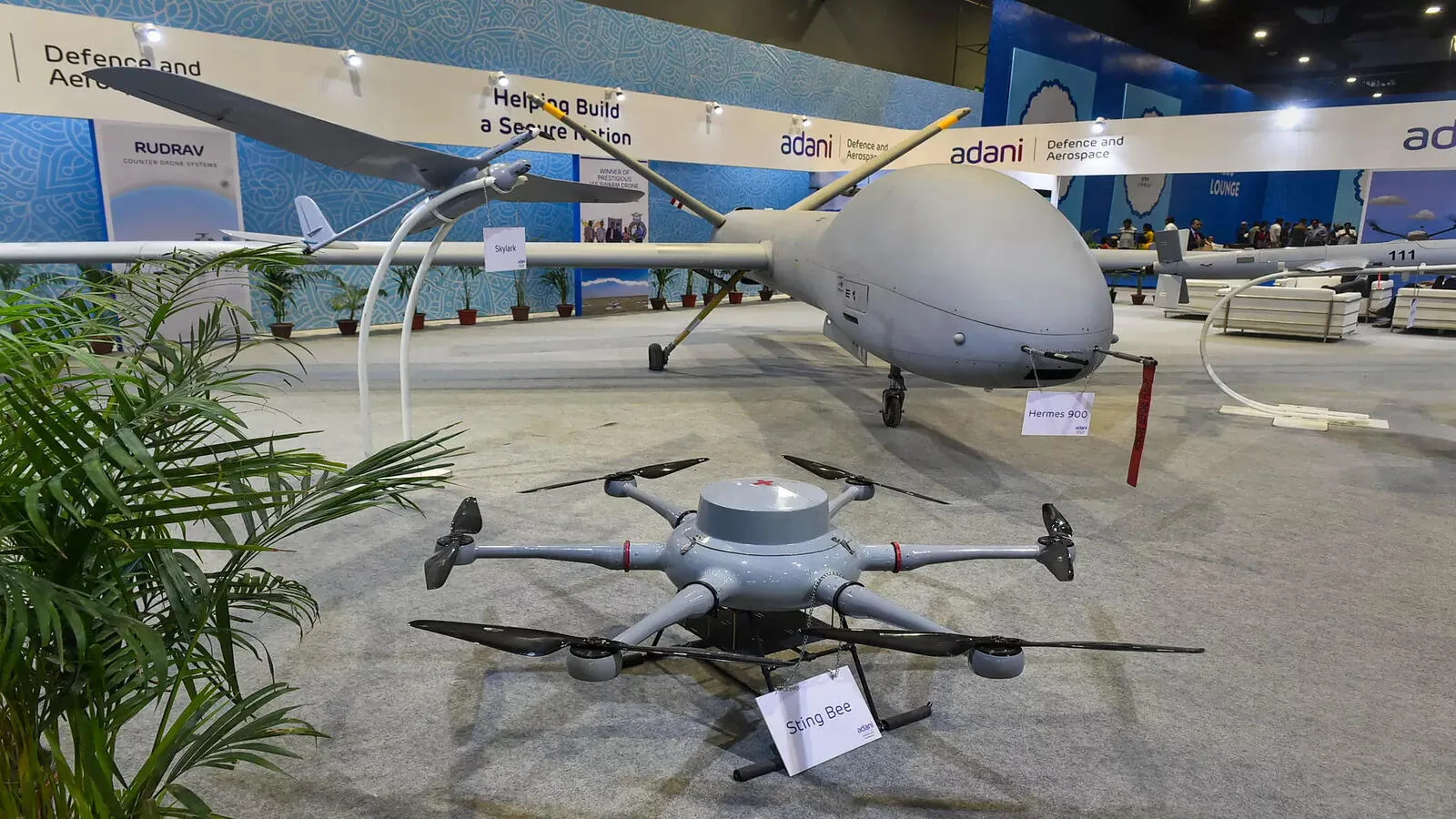
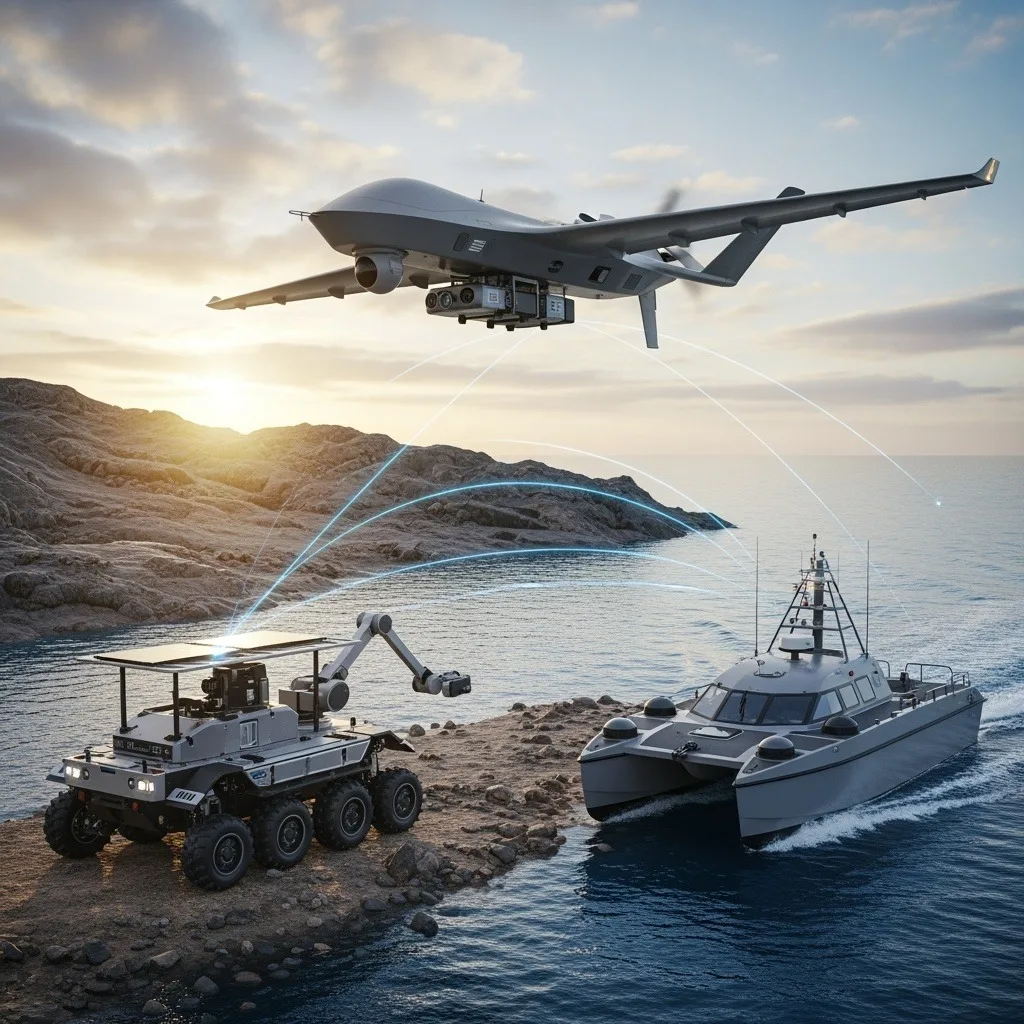
Multi-domain autonomy has stopped being a doctrine paper. A handful of live conflicts have already networked drones, ground robots, satellites and cyber or electronic-warfare tools inside the same fight, and a much longer list of countries is now spending hard to catch up.
Here is who has actually used it, who is moving fastest, and where India sits.
01 · Who has used it in conflict
- +Ukraine. Thousands of aerial and ground robots operating together along the front line, with the Delta situational-awareness system fusing drone, ground-robot and sensor feeds, plus coordinated FPV swarm strikes.
- +Russia. Mass strike packages of hundreds of long-range attack drones combined with missiles, alongside electronic-warfare countermeasures against Ukrainian drones.
- +Israel. Drone swarms reported in strikes on rocket-launch sites in Gaza and against Iranian forces, layered with air-defence and cyber capabilities.
- +United States. JADC2 and the Project Convergence experiments, linking land, air, maritime, space and cyber sensors to shooters across services.
- +China. PLA experimentation with UAV swarms and manned-unmanned teaming, as part of a broader anti-access posture in the Indo-Pacific.
- +NATO, France and the UK. Formal Multi-Domain Operations doctrine at NATO level, with national swarm and deep-strike programmes underneath it.
02 · Who is moving fastest
The United States has created a Defense Autonomous Warfare Group and proposed a sub-unified command for autonomous warfare, with a multibillion-dollar budget behind it. NATO members are writing Multi-Domain Operations into core doctrine.
Ukraine is the interesting case. Its defence-tech sector has been hardened by years of war, and many analysts now treat it as the world leader in practical swarm and autonomy engineering, which is a different thing from having the largest budget.
China continues large-scale swarm testing as part of its Indo-Pacific build-up. Turkey (Baykar), Israel (Elbit Systems, Israel Aerospace Industries) and South Korea are all expanding autonomous, networked systems across their forces.
03 · Where India actually stands
India is moving from single-domain drone projects toward a deliberate, indigenous multi-domain push, led by DRDO and backed by the armed forces and private industry.
- +Swarm drones. DRDO has floated a Technology Development Fund request for a 50-drone swarm, 49 slaves under one master, with over 70% indigenous content and DRDO funding 90% of the development cost.
- +Sovereign swarm algorithms. The Army has launched a project for an indigenous, vendor-independent swarm-control architecture, driven partly by concern over foreign components inside existing drone systems.
- +Layered multi-domain defence. Mission Sudarshan Chakra aims at an AI-enabled networked architecture combining surveillance, cyber protection and physical defence across ground, sea and space-based sensors.
- +Directed energy and counter-drone. DRDO's truck-mounted laser has already been used in trials to bring down drones and defeat a multi-drone swarm attack.
- +Air power integration. HAL's Combat Air Teaming System (CATS Warrior and ALFA-S) and DRDO's Ghatak UCAV both point toward manned-unmanned teaming in the Air Force.
The direction of travel is Atmanirbharata, self-reliance: cutting dependence on foreign components and software for autonomous systems, and pulling private start-ups and MSMEs into the indigenisation drive.
04 · Who is building it in India
- +DRDO, the state R&D body leading swarm-drone, directed-energy and multi-domain command architectures.
- +Hindustan Aeronautics Limited (HAL), on manned-unmanned teaming and combat air-teaming systems.
- +Tata Advanced Systems, on unmanned aerial systems, loitering munitions and system integration.
- +Adani Defence and Aerospace, on loitering munitions and unmanned systems at manufacturing scale.
- +NewSpace Research and Technologies, on swarm systems developed with HAL for the Indian Army.
- +ideaForge Technology, on tactical and surveillance drones for the armed and paramilitary forces.
- +Grene Robotics, on AI-based autonomous air-defence and threat detection.
- +Embodiment Advanced Systems, on the embodied autonomy layer described in the six core pillars.
What this adds up to
The countries already fighting this way did not win an airframe race. They won an integration race, and they are still winning it because their sensors, shooters and networks were built to hand work to each other.
India has the platforms coming. The harder question is whether the assignment and communication layers above them are Indian too, and that is the part we are building.