Multi-domain autonomy: the six core pillars
The six pillars that let unmanned and AI-enabled systems sense, decide and act together across land, air, sea, space and cyberspace.
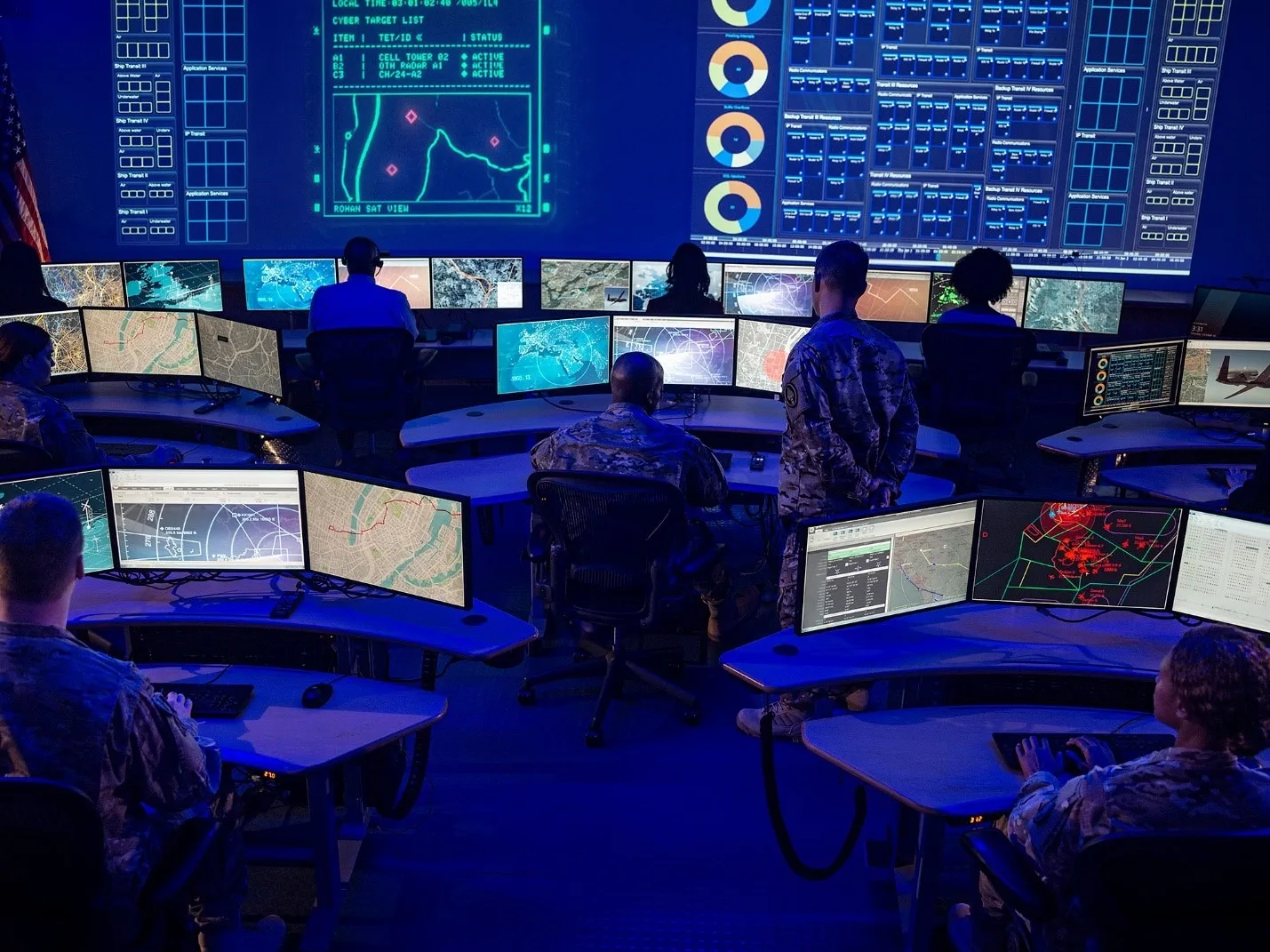
Multi-domain autonomy is the ability of unmanned and AI-enabled systems to sense, decide and act together across every operating environment at once, instead of working as isolated, single-purpose platforms. That covers drones, ground robots, surface and underwater vessels, satellites, and cyber and electronic-warfare tools.
Put plainly: instead of one operator flying one drone, a single commander oversees a networked mesh of air, land, sea, space and cyber assets. They share one picture of the battlefield, and they coordinate their own responses inside it.
01 · From platform-centric to network-centric
Military planners call this the move from platform-centric to network-centric warfare. Individual sensors and shooters matter less than the speed and resilience of the web that connects them.
The forces moving fastest on this, among them the United States, NATO members, Israel, China and India, have organised the idea around a simple three-part loop: sense, make sense, act. It runs continuously, and increasingly it runs without waiting for a human at every step.
02 · The six core pillars
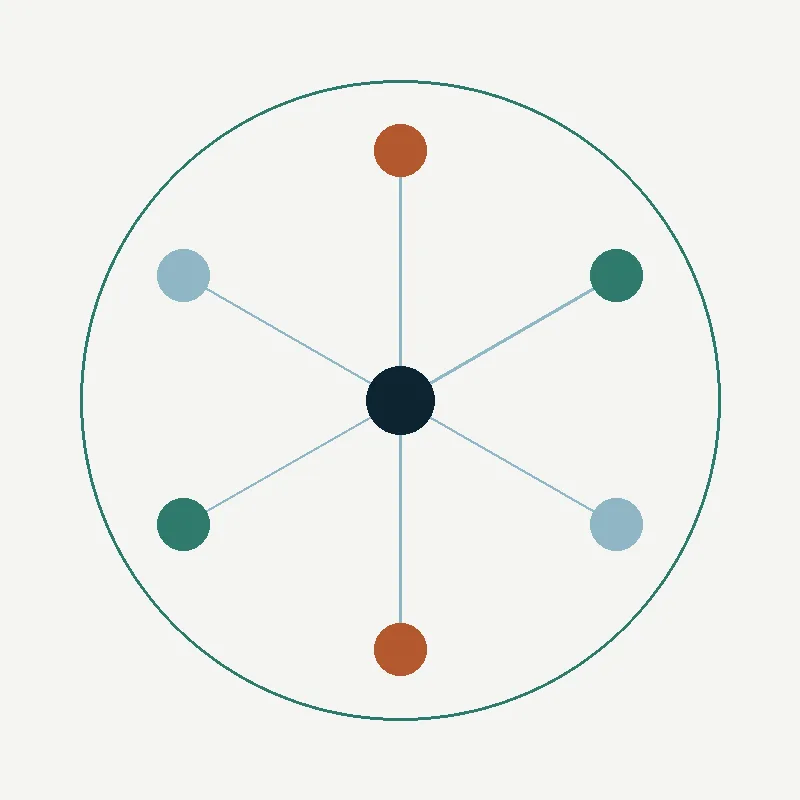
Sense
Distributed sensors collect continuously across every domain rather than one theatre at a time: satellites, radar, drones, seabed arrays, cyber telemetry.
Make sense
AI-driven fusion turns raw, multi-source data into a single shared operating picture, and flags threats faster than manual analysis can.
Act
Autonomous and semi-autonomous platforms carry out the mission, whether that is strike, jamming, resupply or reconnaissance. A human keeps decision authority over lethal action.
Command and control
A joint, interoperable C2 backbone (the US calls its version JADC2) lets any sensor cue any shooter, whichever service or domain happens to own it.
Human-machine teaming
One operator supervises many systems instead of piloting a single one, with rising levels of onboard autonomy filling the gap.
Resilient networking
Mesh communications and swarm coordination have to keep working when satellite links, GPS or radio are jammed or degraded.
03 · What it actually takes
Behind those pillars sit the practical building blocks. Every multi-domain autonomy programme needs all of them:
- +Sensors and ISR. Radar, electro-optical and infrared, acoustic and signals-intelligence payloads, all feeding a common picture in real time.
- +AI and edge compute. Onboard processing for navigation, target recognition and swarm coordination, for the moment the link to a central server is cut.
- +Secure comms mesh. Jam-resistant, low-latency networking that lets platforms talk to each other, not just back to a base station.
- +Common data standards. Shared formats and protocols, so an army drone, a navy sonar buoy and an air-force satellite can understand one another.
- +Autonomous platforms. A mix of expensive "exquisite" systems and cheap, attritable ones that can be built and lost at scale.
- +Cyber and EW resilience. Hardened software and spectrum management, enough to survive jamming, spoofing and intrusion.
- +Doctrine and training. Updated rules of engagement, certification standards and command structures built for machine-speed decisions.
- +Governance. Legal and policy frameworks that define where a human has to stay in, or on, the decision loop.
Why this matters for what we build
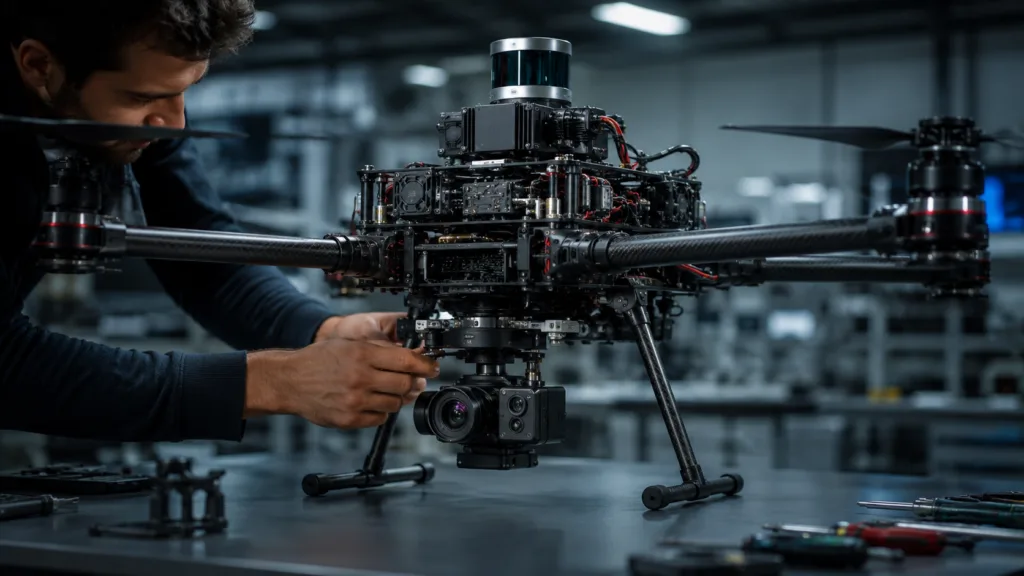
Every one of those ingredients is an integration problem before it is a hardware problem. A programme can hold the best sensor in its class, the best airframe in its class and the best radio in its class, and still not have multi-domain autonomy. None of the three were designed to hand work to the others.
That handover layer is the part we build.