Autonomous warfare: from Ukraine to the next decade
How multi-domain autonomy is already changing the battlefield, and where it is likely to take conflict next.
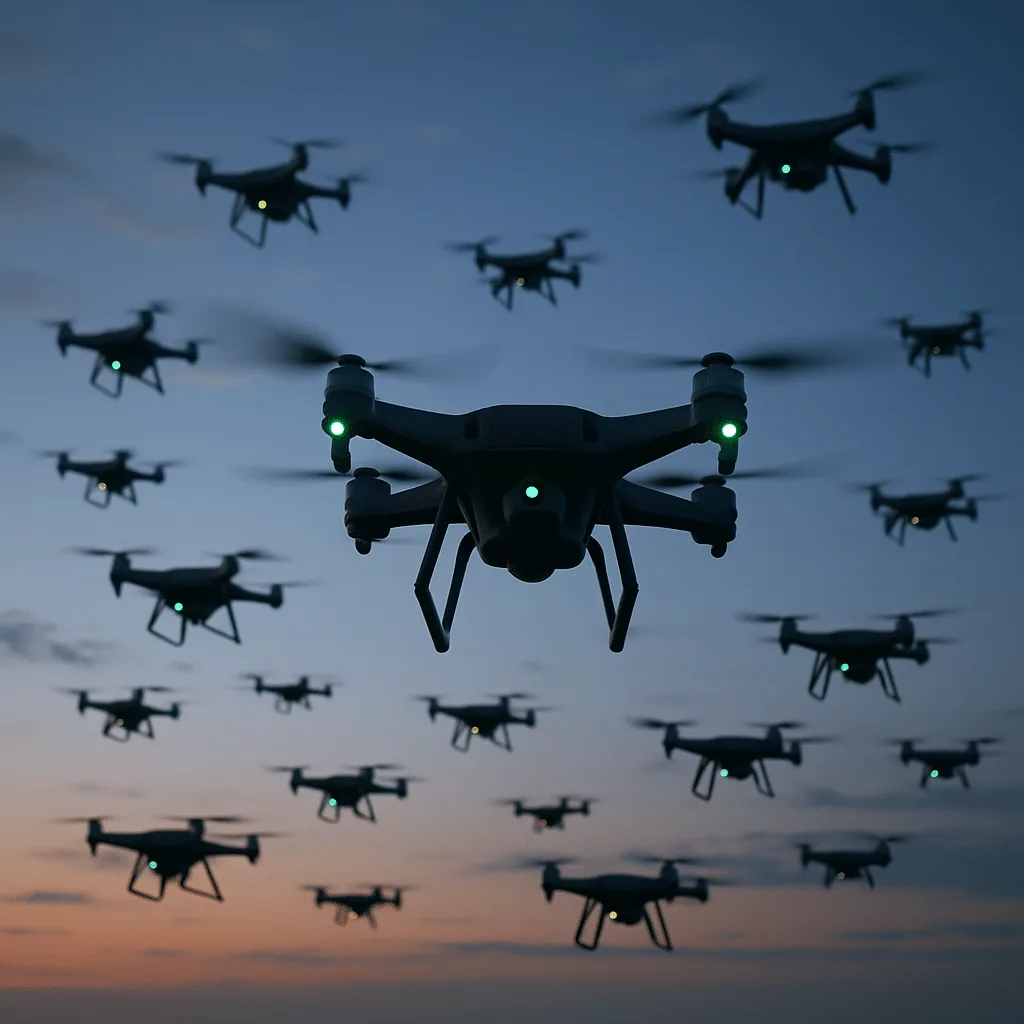
The clearest real-world proof of multi-domain autonomy today is the war in Ukraine, where thousands of ground robots now operate alongside aerial drones along the front line.
Most are doing resupply and casualty evacuation. But armed, remotely controlled ground robots have already been used to detect and engage soldiers at night, and analysts believe Ukraine has fielded at least one fully autonomous unmanned system in combat.
01 · An already-transparent battlefield
Both sides have moved from one operator flying one drone toward one operator supervising many. They coordinate waves of ten to twenty first-person-view drones against a single target, and use AI-enabled swarms to saturate air defences.
Ukraine's Delta situational-awareness system now links drones, ground robots and sensor feeds into a single software-defined command network. It is a working, wartime version of the sense, make sense, act loop.
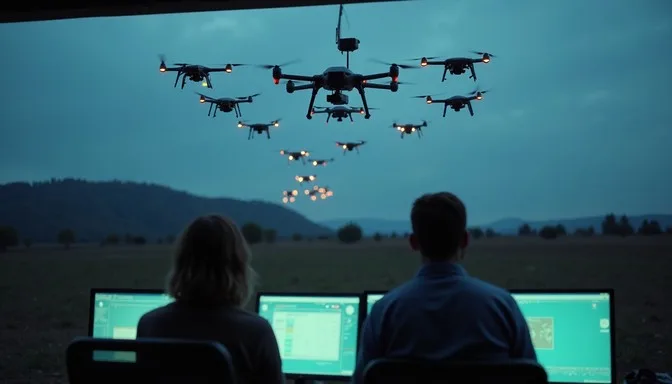
Why it matters. Moving the operator-to-drone ratio from one-to-one to one-to-many turns warfare from a manpower problem into a production problem. Every major military is now racing to copy it.
02 · How doctrine is catching up
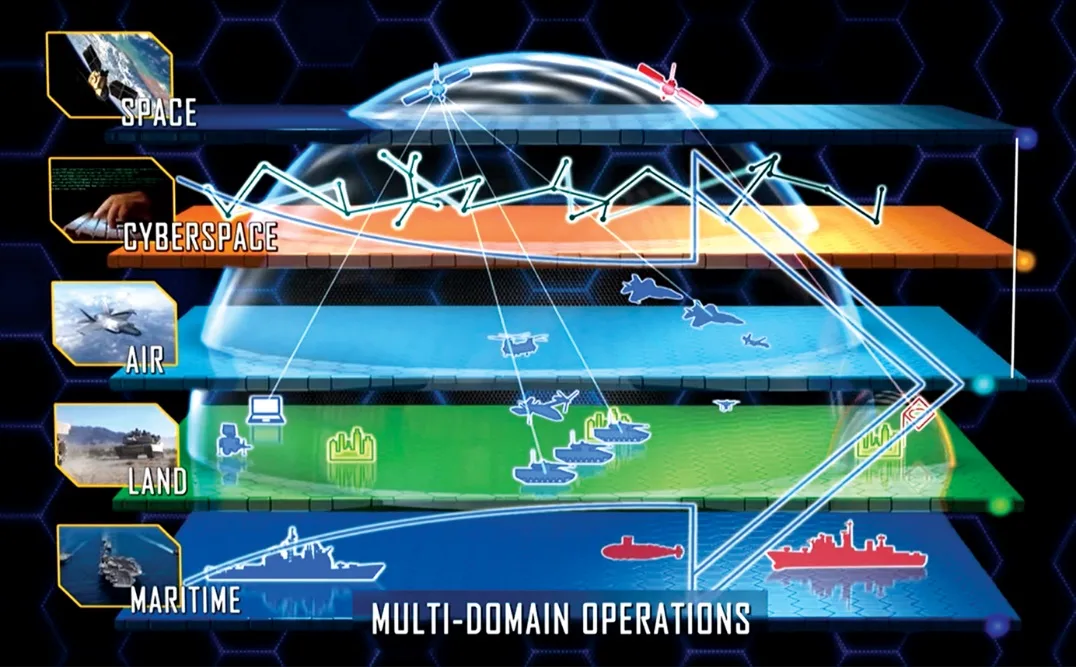
Militaries are rebuilding their organisations around this rather than treating it as a side project. The United States has stood up a Defense Autonomous Warfare Group and, more recently, a dedicated sub-unified command for autonomous warfare. That sits alongside the Army's Project Convergence experimentation campaign and the joint C2 effort known as CJADC2. NATO has adopted an explicit Multi-Domain Operations concept to synchronise military and non-military action across every domain at once.
The pattern repeats elsewhere with local variations. Taiwan and its partners now argue that the seas and airspace around the island should be treated as one integrated theatre rather than separate zones, precisely because an adversary skilled in multi-domain coercion will not respect old boundaries between "naval" and "air" problems.
03 · Where this is heading
Mass over exquisite
Expect the shift to continue, away from small numbers of expensive "exquisite" platforms and toward large numbers of cheap, attritable autonomous systems that can be built and lost at scale.
Comms-denied autonomy
Jamming degrades a swarm quickly. Future systems will need to keep coordinating and finishing the mission even when links to base are gone.
Faster kill webs
Sensor-to-shooter timelines will keep compressing as AI fusion and edge computing strip manual steps out of targeting decisions.
Contested governance
Accountability for autonomous mistakes, and the question of where a human has to stay in the loop, remain unresolved. They will shape future rules of engagement.
Integration decides it, not any one weapon
The near-consensus among defence analysts is that integration, not any single novel weapon, will decide who benefits most. Drones, loitering munitions, ground robots, electronic warfare and AI targeting only pay off once they are fused into one coherent, resilient kill web. Deployed as isolated gadgets, they do not.
Militaries that master that integration, and that can out-produce and out-adapt an opponent's countermeasures, are expected to hold the advantage in the conflicts of the next decade.
That fusion layer, the part that makes a sensor from one service usable by a shooter from another, is what we build.