Six missions that need more than one machine
Each is set out as a concept of operations — the problem, the sequence, the force mix, and what degrades it. No case studies, because we have not earned any yet.

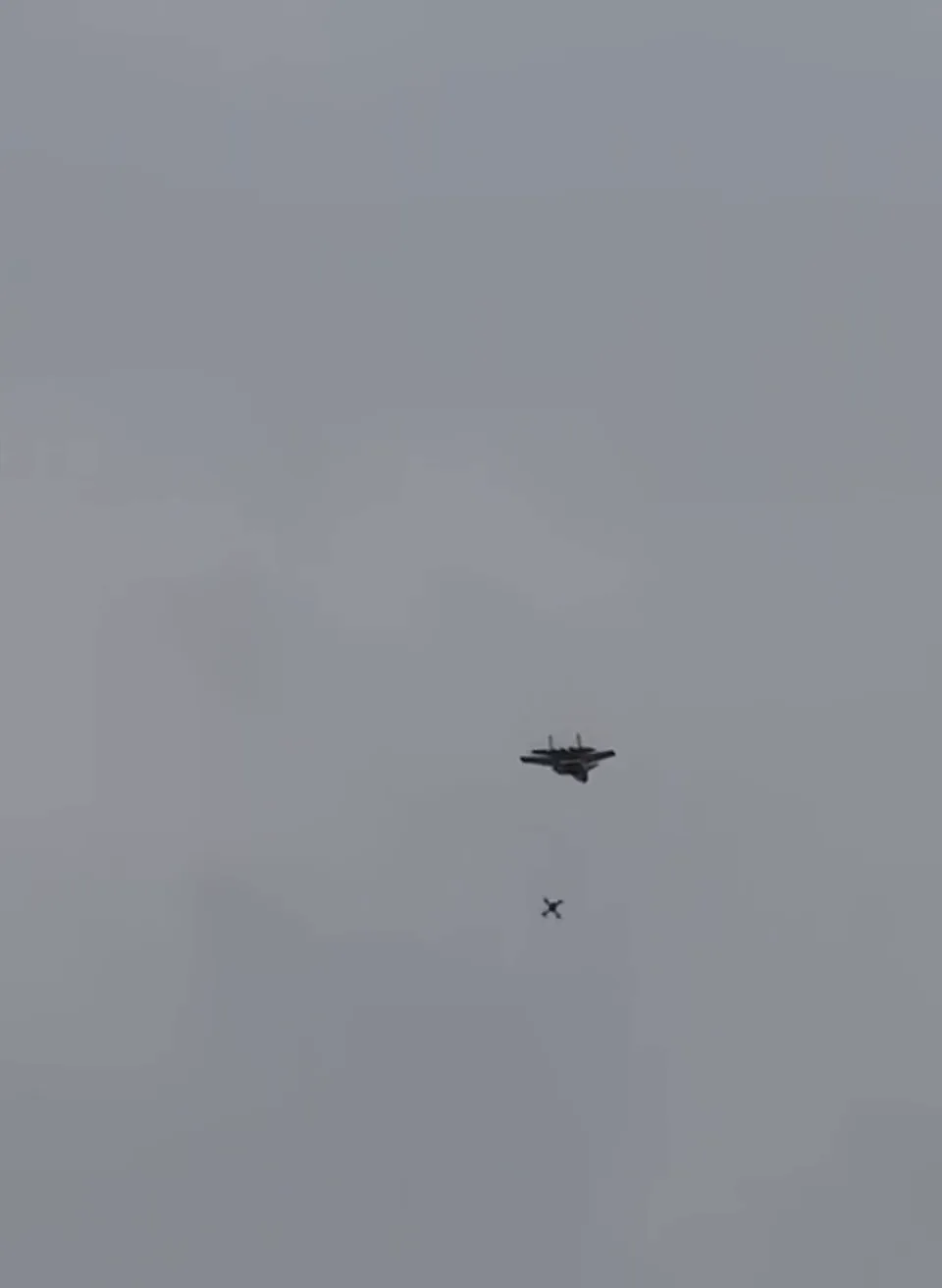
A small aircraft crosses into a protected area at low altitude. It is slow, it is cold, and it sits below the elevation where most ground radar looks. By the time it is close enough to identify by eye, it is close enough to matter.
Layered detection and interception around a fixed area
Control-link emissions are detected and coarsely geolocated well before visual range.
An airborne sensor is cued onto the bearing to classify the contact by shape and behaviour.
Classification and track are presented. Any response beyond observation requires the operator to authorise it.
An interceptor launches on a computed intercept solution rather than a stern chase.
A ground node holds the low-altitude picture the aircraft lose when they commit.
Remaining assets close the gap left by the committed interceptor, so a second contact does not find an open lane.
7 assets, one operator
What degrades this, and what the system does about it
Stated plainly because an evaluator will find these anyway. Mitigations are design decisions, not guarantees.
An intruder flying a preloaded route emits nothing, so passive RF detection has nothing to find.
RF detection is one layer, not the layer. EO/IR and the ground sensor cover the emissions-silent case, and the screen is built so no single sensor type is load-bearing.
Birds, terrain and structures generate false contacts in exactly the band that matters.
Classification requires agreement between two sensor types before a contact is promoted. Single-sensor contacts are shown but not acted on.
An intruder at 20 m/s crosses the useful detection band faster than an aircraft can launch and climb.
Detection range, not interceptor speed, sets the timeline. The RF layer is positioned to buy climb time, and the operator sees the intercept window before authorising.
Several contacts at once exhaust the available interceptors and open a lane.
The screen reforms around committed assets rather than holding a fixed pattern, and the operator is told plainly when the screen is below strength.
Any engagement over a populated or friendly area carries consequences the system cannot judge.
Geographic no-engagement zones are set before the mission and the authorisation gate is never removed. The system will not offer an action it is not permitted to take.
Take this mix into the fleet builder
Bring a mission, not a shortlist
We will walk the concept of operations against your requirement and say plainly where it does not fit.